

Core Process: Extruder + Strand Cooling and Cutting Pelletizing
Process Steps:
Pretreatment: Waste PE/PP materials (e.g., films, bottles, crates) are sorted, cleaned, and crushed.
Melting and Extrusion: The crushed fragments are fed into a single-screw or twin-screw extruder via a feeder. During this stage, fillers, color masterbatches, toughening agents, etc., can be added for modification.
Filtration: The molten material passes through a screen changer to filter out impurities.
Extrusion, Cooling, and Pelletizing: The molten material is extruded into thin strands through a die with a multi-hole template → enters a water bath for cooling and shaping → undergoes dewatering → is fed into a pelletizer to be cut into uniform pellets.
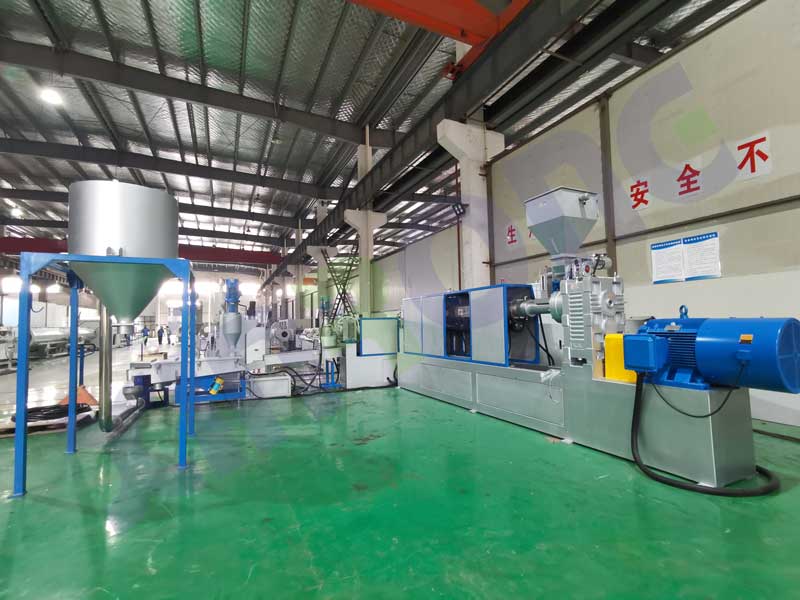
Core Equipment:
Twin-screw extruder (particularly for modification, offering excellent mixing effects) or a forced-feeding single-screw extruder (commonly used for recycling).
Other Auxiliary or Special Pelletizing Methods:
Underwater Pelletizing: Also used for high-end modified materials (e.g., engineering plastic alloys, high-filling masterbatches). Produces pellets with excellent appearance and is suitable for large-scale continuous production.
Water Mist/Air Cooling Pelletizing: After extrusion into strands, the material is not passed through a long water bath but is instead cooled with water mist or air before cutting. Suitable for moisture-sensitive materials or those requiring rapid cooling.
Hot Die Face Cutting Pelletizing: Used for extremely high-viscosity melts (e.g., ultra-high molecular weight PE).
Differences and Selection Points for PE and PP Pelletizing Methods:
Although the processes for both materials are similar, differences in material properties lead to variations in focus:
PP (Polypropylene):High crystallinity, slow cooling: More inclined toward underwater pelletizing with high cooling efficiency to prevent particle adhesion. Underwater pelletizing is the absolute dominant process for PP polymerization.
Isotactic PP: Highly prone to crystallization, almost exclusively uses underwater pelletizing.
PE (Polyethylene):Wide range of grades: LDPE, LLDPE, HDPE, each with distinct properties.
LDPE/LLDPE: High melt strength, suitable for water ring pelletizing, producing pellets with excellent appearance. This is the preferred method for high-transparency film-grade materials.
HDPE: Both underwater and air-cooled hot cutting methods are commonly used, with underwater pelletizing being more prevalent. Less sensitive to cooling speed compared to PP: Therefore, air-cooled hot cutting is still used in small-scale PE production.
Jiangsu Xinrongplas Machinery Co., Ltd. is specialized in the production of pp pe wasted plastic bottle ,film, bag washing and pelletizing lines. We are looking forward to cooperating with you.